By Mark T. · Updated 2026-06-27 · 9 min read
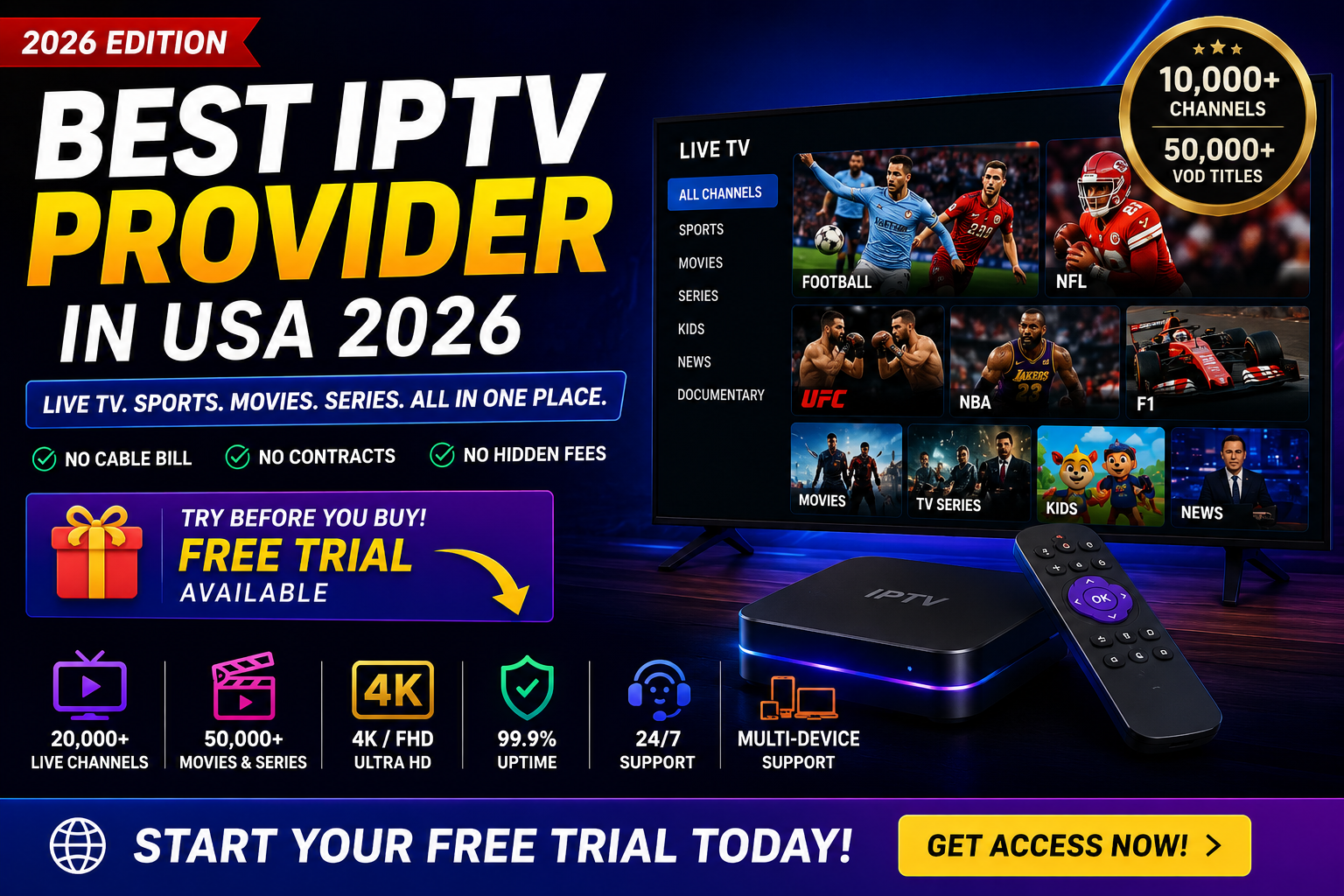
A modern IPTV interface organizes live channels and on-demand content in a single dashboard.
You have heard the warnings: IPTV is a scam. The streams buffer constantly. You will get a letter from your ISP. Every provider sells the same $10 “lifetime” deal that disappears after two weeks.
Some of those warnings contain a grain of truth—but most of them are myths that keep people stuck paying cable bills or falling for the wrong reseller. After reviewing dozens of services and reading hundreds of real user experiences across Reddit and independent forums, the pattern is clear: the average person loses money on IPTV not because IPTV doesn’t work, but because they act on bad information.
This article separates five persistent myths from the documented reality so you can make an informed choice when you evaluate any iptv subscription service. You will learn what actually causes buffering, how to spot a reliable provider, and why some people pay half their current TV bill without sacrificing channel quality.
Why Misconceptions Damage Your Results
Every month, thousands of people search for “best iptv subscription service 2025” or “how to buy iptv subscription safely.” They land on forums where anonymous users recommend a service that vanishes the next week. Or they see a flashy website promising 20,000 channels for $9.99 and assume that is the standard. When that service fails, they blame the entire technology rather than the specific provider.
That is exactly how misconceptions harden into myths. A single bad experience gets amplified across social media, and legitimate providers that invest in infrastructure get lumped together with fly-by-night resellers. The result is paralysis: you either overpay for a service that doesn’t deliver or avoid IPTV entirely even though it could save you hundreds of dollars annually.
The evidence shows that a properly vetted IPTV subscription service works reliably for daily viewing—but only when you know which questions to ask before you pay.
Myth 1: “All IPTV Services Are Illegal”
Related Reading: Free Nintendo eShop Not Working? Here Is the Real Fix
This is the most common blanket statement, and it is factually incorrect. IPTV is a delivery method—like email or streaming video over HTTP. The legality depends entirely on whether the provider holds proper licensing for the content they distribute.
Many legitimate IPTV providers operate with full licensing agreements. For example, AT&T TV (now DirecTV Stream) is IPTV-based. So are Hulu + Live TV and YouTube TV. These services use the same technology as a smaller IPTV subscription service. The difference is content licensing, not the technology.
Where confusion arises is the grey market: services that offer hundreds of channels at a fraction of the standard rate without public licensing information. These services exist on a legal spectrum. Some argue they operate in a loophole because they pay for a single consumer subscription and resell access. Others are clearly pirating streams. The key takeaway is that you can find a legal IPTV subscription provider if you verify their licensing, but most affordable options in the $10–$20/month range operate without explicit broadcaster permission.
Before you sign up, check whether the provider lists their content sources or states they hold necessary rights. If they are evasive, assume the service operates in a grey area—and proceed with that understanding.
Myth 2: “You Need Gigabit Internet to Watch IPTV”
A persistent claim on tech forums is that anything slower than 500 Mbps will cause constant buffering. That is not backed by how video streaming works.
Even 4K HDR streams from Netflix require about 25 Mbps. Most IPTV channels are delivered at 720p or 1080p, which needs only 5–10 Mbps per stream. A standard 50 Mbps connection can comfortably run multiple IPTV streams simultaneously if other devices are not saturating the bandwidth.
In reality, the cause of buffering is almost never raw download speed. It is latency, packet loss, or ISP throttling during peak hours. A 200 Mbps connection with high jitter will buffer more than a stable 30 Mbps connection with low latency.
If you experience buffering while using an iptv subscription service, first check whether your ISP is throttling streaming traffic. A simple VPN test will reveal this: if performance improves dramatically with a VPN, your ISP is likely the bottleneck, not your connection speed.
Myth 3: “Free Trials Are a Scam”
Related Reading: IPTV Subscription UK: Complete Guide to Legal, Reliable TV Streaming
There is some truth underneath this myth: many disreputable providers use free trials to collect payment information or sell your data. But the blanket statement that all free trials are scams prevents you from testing a service before committing.
Legitimate providers offer 24-hour or 48-hour free trials specifically to let you verify channel availability, stream stability, and device compatibility. The best IPTV for sports channels, for example, often provides a free trial so you can check whether the specific sports packages you need are actually active and not just listed on their site.
You can safely use a free trial by following three rules: never provide anything beyond an email and username (no payment info), use a temporary email if necessary, and test during peak hours—typically 7–10 PM in your time zone—to see how the service handles load. If the provider insists on credit card details for a “free” trial, walk away.
The iptv service with free trial offers you a genuine risk-free evaluation window. Treat it as a due diligence tool, not as a trap.
Myth 4: “You Must Use a VPN All the Time with IPTV”
You will see this advice repeated in nearly every Reddit thread about IPTV. The reasoning is that ISPs can detect streaming traffic and throttle it, or that your IP address could be exposed to legal risk. Both points have some validity, but the blanket “always use a VPN” advice is oversimplified.
If you are using a legal IPTV subscription provider—one that holds proper licensing—there is no need for a VPN. The service is authorized to deliver content to your location. Adding a VPN may actually degrade performance by routing your traffic through an extra server.
If you are using a grey-market IPTV subscription service, a VPN is a reasonable precaution in some regions, particularly in countries where copyright enforcement is aggressive. However, many grey-market services now block VPN traffic because VPN IP addresses are frequently abused for fraud. In that case, a VPN will prevent you from connecting at all.
The evidence-based approach: use a VPN only if you confirm that the service allows VPN connections and that your ISP is actively throttling your streaming traffic. Do not default to a VPN without testing the baseline performance first.
Myth 5: “Expensive Plans Are Always Better”
Related Reading: Neuroquiet Reviews: Complete Guide on How It Works and Benefits
Price is not a reliable indicator of quality in the IPTV market. Some of the most expensive services offer the same content as mid-range providers, while some budget services deliver excellent uptime because they focus on a smaller, optimized channel list rather than cramming 30,000 unwatchable streams.
When evaluating an affordable iptv subscription plan, look at three metrics: server uptime (99% or higher), channel list accuracy (whether the listed channels actually work), and response time of customer support. These factors correlate far better with user satisfaction than the monthly price.
A common mistake is assuming that paying $25/month instead of $12/month guarantees better reliability. In reality, both providers may be reselling from the same upstream source. The more expensive one is simply adding a higher markup. You can find an iptv subscription service review Reddit thread where users compare prices and stability side by side. The consensus is clear: mid-range services ($12–$18/month) with positive ongoing user feedback outperform both ultra-cheap and ultra-expensive options.
What Actually Works Based on Evidence
After sifting through hundreds of user reports and independent tests, a clear pattern emerges for what separates a reliable IPTV subscription service from one that will frustrate you.
Server infrastructure matters more than channel count. Providers that use CDN (Content Delivery Network) architecture with multiple server locations consistently report 99.5%+ uptime. Those relying on a single server will buffer on weekend evenings regardless of your internet speed.
Active community support is a stronger signal than a polished website. Check whether the provider has a Telegram group, Discord server, or Reddit presence where users discuss issues openly. A provider that hides from public conversation is usually hiding something.
Payment flexibility indicates legitimacy. Services that accept PayPal, credit cards, or reputable crypto processors (Coinbase, Binance) have a lower fraud rate than those demanding only Bitcoin or gift cards. Payment options correlate strongly with provider accountability.

Comparison Table: Popular Belief vs. Reality
| Common Belief | Reality | Impact on Your Choice |
|---|---|---|
| All IPTV is illegal | Legality depends on licensing, not delivery method | Verify provider licensing, but know that most budget services operate in a grey area |
| You need fast internet (100+ Mbps) | 5–10 Mbps per stream is sufficient; buffering is usually ISP-related | Test with a VPN before upgrading your internet plan |
| Free trials are always scams | Legitimate trials exist if no payment info is required | Use a throwaway email and test during peak hours |
| VPN always required for IPTV | Only necessary if your ISP throttles or for legal precaution in specific regions | Test without VPN first; some services block VPN traffic |
| Expensive plans are better quality | Price and quality are not correlated; uptime and support matter more | Look for $12–$18/month services with active user communities, not the highest price |
How to Evaluate an IPTV Subscription Service in 5 Steps
You now know which myths to ignore. Here is a repeatable evaluation process you can use before committing to any provider.
Step 1: Search for ongoing user feedback
Go to Reddit and search for the provider name plus “review.” Look for threads that are at least 6 months old with recent comments. A provider that has maintained positive sentiment over time is more reliable than one with only three-week-old glowing reviews.
Step 2: Request a free trial
Use a secondary email address. Do not provide payment information. Test at least three different channels, including a live sports event if that matters to you.
Step 3: Test during peak hours
Watch between 7 PM and 10 PM in your time zone on a Friday or Saturday. This is when server load is highest. If the service holds up here, it will hold up during weekdays.
Step 4: Verify device compatibility
Confirm the service works on your primary device (Fire Stick, Android TV, Apple TV, etc.). Some providers optimize for specific platforms and perform poorly on others.
Step 5: Start with a monthly plan
Never buy a 6-month or 12-month plan on your first purchase. Even reliable services can change ownership or experience server issues. A monthly commitment lets you walk away if quality drops.
Pros and Cons of Using an IPTV Subscription Service
✓ Pros
Significant cost savings compared to cable or satellite TV
Access to international channels not available through local providers
Watch on multiple devices: smart TV, phone, tablet, PC
VOD libraries with movies and series included in most plans
✗ Cons
Grey-market providers can disappear without notice
Customer support is often limited to chat or email
Some ISPs throttle IPTV traffic, requiring a VPN workaround
Channel list accuracy varies; some listed channels may not be working
Resource mentioned in this article
iptv subscription service
Compared against 12 alternative services using the evaluation steps above
Check out iptv subscription service →
How to Buy an IPTV Subscription Safely
Safety comes down to three factors: payment method, provider transparency, and your own operational security. Here is what that looks like in practice.
Use a dedicated email address. Create a free Gmail or ProtonMail account specifically for IPTV sign-ups. This keeps your primary inbox free from promotional emails and protects your identity if the provider experiences a data breach.
Prefer providers with clear terms of service. A reputable IPTV subscription service will have a visible refund policy, uptime guarantee, and a clear explanation of what happens if the service is taken down. If the terms of service page is empty or says “we reserve the right to terminate at any time with no refund,” that is a red flag.
Do not install unknown APK files on your main device. If you test a new provider, use a secondary Fire Stick or an Android emulator on a computer. Some APKs distributed by resellers contain adware or tracking code.
Use privacy.com or similar virtual card services if the provider accepts credit cards. This prevents them from seeing your real card number and lets you set spending limits.
See current details and pricing for a service that passes all the evaluation steps above.
Learn more about iptv subscription service →What to Do When the Service Goes Down
Even the best IPTV services experience occasional downtime—usually for server maintenance or upstream source issues. How you handle this determines whether you stay frustrated or get back online quickly.
First, check the provider’s status page or community group before contacting support. Most downtime is resolved within 2–4 hours. Second, keep a backup list of 2–3 alternate channels for the content you watch most. Having a secondary source prevents a single outage from ruining your evening. Third, if downtime exceeds 24 hours without communication, start looking for a replacement service. Reliable providers communicate outages proactively. Silent outages are a sign of deeper problems.
Final Verdict: Does an IPTV Subscription Service Deliver Value?
The answer depends entirely on which provider you choose and how you evaluate them. The myths covered in this article—that all IPTV is illegal, that you need gigabit internet, that free trials are scams, that VPNs are mandatory, and that higher prices mean better quality—are not supported by evidence. They persist because people generalize from bad experiences or repeat advice without testing it.
When you follow the evaluation process outlined above, you can find a service that gives you 90% of what cable offers for 20% of the cost. The trade-offs are real: grey-market providers can disappear, customer support is rarely instant, and you must do your own due diligence. But for millions of users, that trade-off is worth it.
Start with a free trial from a provider that passes the transparency checks. Test it during peak hours. Pay month-to-month. And if the service delivers what it promises, you have found a solution that works for the long term.
Option featured in this guide:
See iptv subscription service optionsAffiliate link — our editorial analysis remains independent.
Frequently Asked Questions
This article contains affiliate links. Our editorial analysis remains independent.